What this guide covers
- Trim: SOPs and cutting to customer specs for meat processing yield improvement
- Check: checkpoints and controls that prevent rework and giveaway
- Recapture: by-product capture and routing products to the best customer
- Automate: how modern vision systems unify all three to compound gains
Trim: SOPs and cutting to customer specs
A 1.5% meat processing yield improvement often starts with the fundamentals. Precision trimming is where most processors either silently lose value through over-trim and rework or gain it through standardized practices.
Standardize trim plans to customer spec
Create a visual trim plan per SKU and per customer spec. Use side-by-side reference photos of acceptable trim, fat coverage, squared ends, and tail lengths. Post at the station and include simple, bold measurements operators can see at a glance. This alone can drive measurable meat processing yield improvement when adhered to daily.
Turn SOPs into micro-drills
Break high-variance cuts into short repeatable drills. A 5-minute drill at shift start on the day’s high variance specs will lower over-trim and rework for the full run, a reliable lever for meat processing yield improvement.
Close the expertise gap
Pair new operators with top performers for short, focused reps. Measure individual variance on the spec features that matter most to value. In many plants, the variance between novice and expert cutters drives most yield leakage; targeted coaching closes the gap and supports meat processing yield improvement.
Knife and workstation readiness
The right blade, sharpening cadence, stable posture, lighting, and cut platform height reduce fatigue and cut scatter. Small frictions compound into measurable over-trim over a shift.
What to measure in this section
- Over-trim rate on each spec feature
- Spec conformance on first pass
- Operator-to-operator variance on the highest-value cuts
Removing half a percentage point of variance during slicing or trimming can equate to millions recovered for large operators.
Checking: checkpoints and controls that prevent rework and giveaway
The fastest way to lose yield is to discover problems late. Tightening your feedback loops turns slow, expensive corrections into fast, cheap ones that contribute to meat processing yield improvement.
Scale checkpoints at known risk points
Place calibrated scales just upstream of giveaway hot spots like portioning and post-slice trim. Weigh samples at cadence, not at convenience. Move from end-of-line discovery to in-process correction for sustained meat processing yield improvement.
In-line visual management
Use color-coded spec boards, defect photo walls, and pull-and-correct cues. Real-time visual indicators help operators and leads intervene within minutes rather than hours.
Daily “yield huddle”
Run a 10-minute stand-up over five metrics:
- First-pass yield
- Rework rate
- Over-trim rate
- Giveaway
- Spec conformance
Keep a whiteboard or dashboard at the line; red/yellow/green the metrics and list the day’s one countermeasure per metric.
Keep QC close to the work
Position your defect checks and spec verification near their source. The longer the distance and time to feedback, the more rework you accumulate.
Manage line speed realistically
Poultry line speeds can be extremely high—USDA permits up to 175 birds per minute in certain programs. Fit your check cadence to actual speed or it will be ignored in practice.
What to measure in this section
- Time from defect discovery to correction
- Percentage of issues detected in-line versus end-of-line
- Giveaway drift versus target at each checkpoint

Recapturing: by-product capture and right-customer allocation
Even when trimming and checking are solid, value can leak in how you route by-products and finished pieces. Strong recapture practices drive meat processing yield improvement by monetizing what would otherwise be lost.
Separate and monetize by-products
Feathers, bones, and offal represent a large share of live weight in poultry and meaningful value in red meat. Efficient separation and routing recover dollars and prevent cross-contamination that forces rework.
Allocate product to the best customer spec
When multiple customers have differing specs and price points, aligning each piece to its best-fit spec maximizes realized value and reduces downgrades. This matters most for high-variance items and borderline pieces.
Prevent misallocation at the source
If routing happens late or manually without measurement, the plant eats avoidable downgrades. Add an allocation check early, tied to measured features, not only visual judgment.
Further-processed yield matters too
For marinated or cooked items, tumbling and massaging practices that enhance protein extraction and water binding reduce cook loss and improve yield. Use intermittent cycles and vacuum to strengthen bind and shorten cycle time without damaging texture.
What to measure in this section
- By-product recovery percentage by category
- Downgrade and misallocation rates
- Cook loss percentages for further-processed items (before/after parameter changes)
Plants implementing real-time visibility and guided correction commonly recover around 1–1.5% yield improvement while improving spec conformance and reducing rework.
Automation that unifies trim, checking, and recapturing for meat process yield improvement
The fastest way to compound gains is to measure every product in motion and turn that data into instant, actionable guidance. This is where automated systems accelerate meat processing yield improvement by making best practices consistent and continuous.
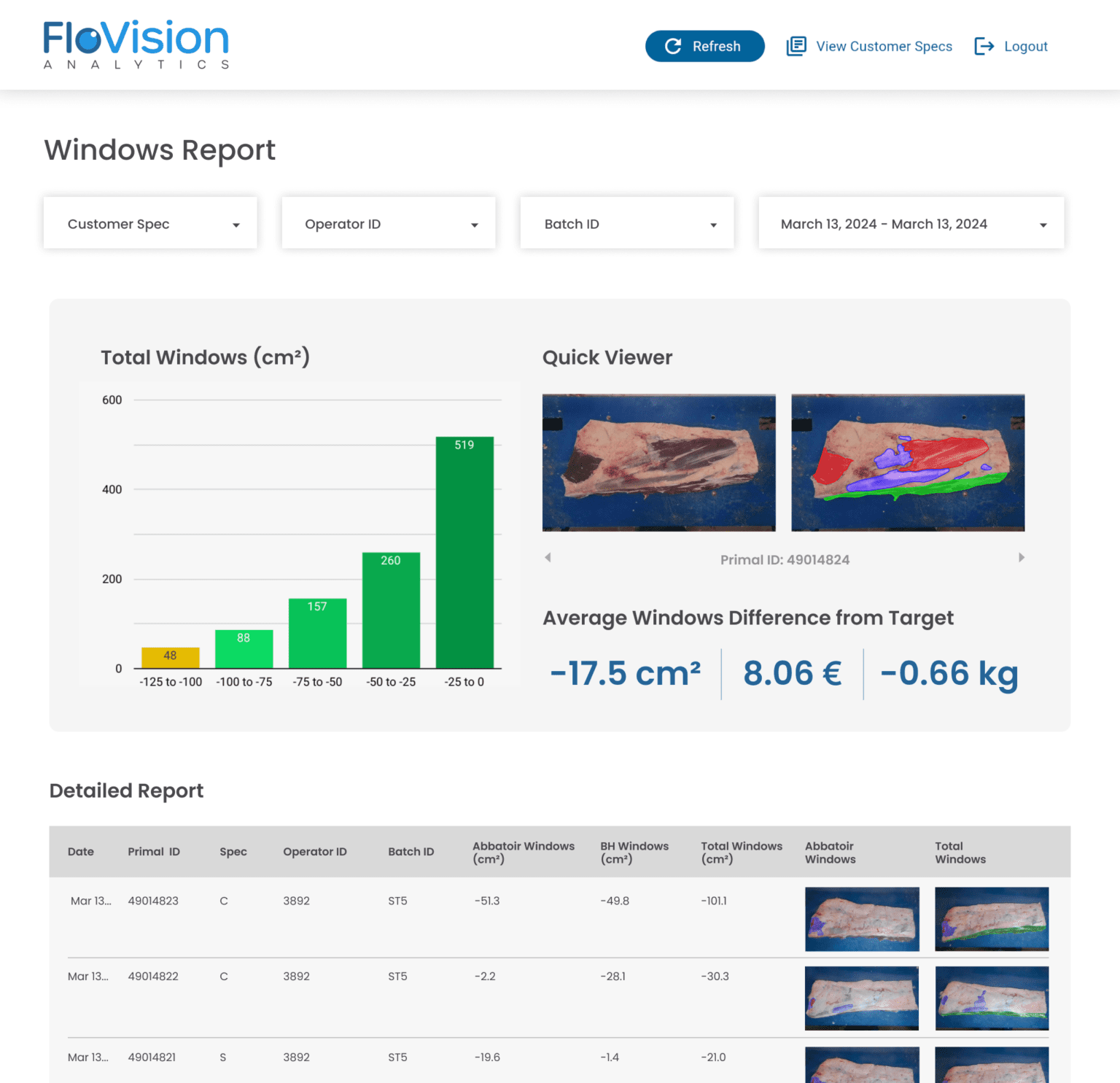
Line-wide visibility and sorting: FloVision Nano
FloVision Nano scans, measures, and tracks each product on a production conveyor. It flags yield loss, foreign bodies, spec compliance issues, defects, quality deviations, and performance issues, while offering traceability across the entire production system. It can automatically sort products by grade, customer spec, or product type to place each piece where it creates the most value.
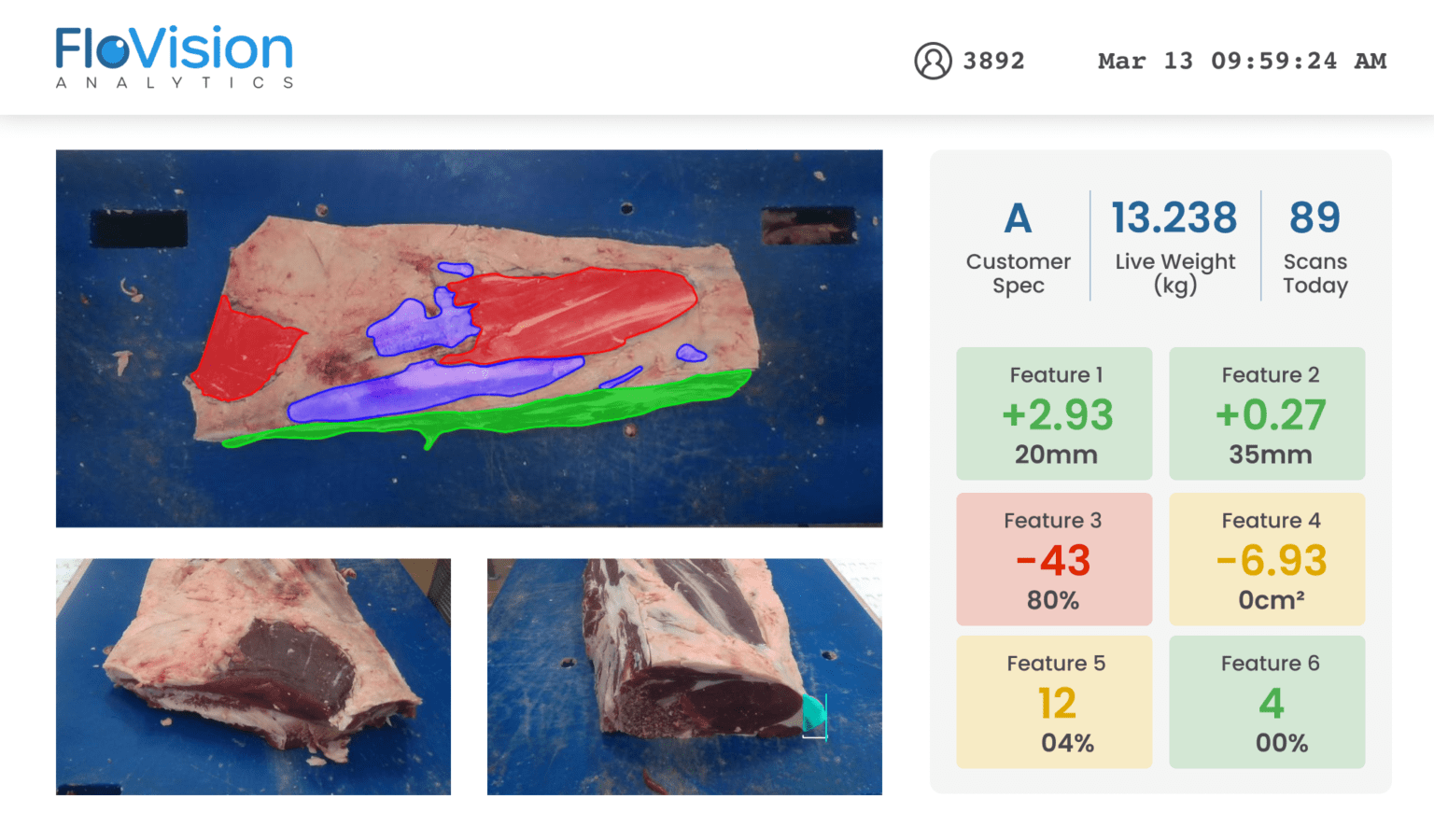
Station-level guidance and feedback: FloVision Pro
FloVision Pro valuates products at the station and provides real-time feedback on yield loss, spec conformance, defects, operator performance, and product quality. Laser or projection guidance helps operators make the precise cuts that align with the spec, reducing over-trim and rework while upskilling less experienced cutters.
Automation integrates with your systems to improve yield
- Trim: Operators cut to spec with visual guidance at the moment of decision
- Checking: Deviations trigger immediate correction, not end-of-line rework
- Recapturing: Pieces are routed and sorted to the highest-value destination automatically

ROI snapshot
Consider a mid-size beef or pork plant. If your annual sellable output is $100M, a 1.0% meat processing yield improvement translates to roughly $1M of additional sellable product at similar inputs. At 1.5%, that’s $1.5M. The same logic applies to poultry at higher throughputs, where small per-piece improvements compound quickly at line speeds approved up to 175 BPM.
Pulling it together
The route to a repeatable 1.5% meat processing yield improvement is not a single silver bullet. It is a disciplined combination of:
- Clear trim standards and operator coaching
- Tight in-line checks that surface problems in minutes, not hours
- Thoughtful recapture that monetizes by-products and routes pieces to the right customer
- An automation overlay that measures 100% of the line and guides operators in real time
Plants that invest in automated systems see the most durable gains. Start with one high-variance SKU and one conveyor or station pilot. Prove it, then scale.
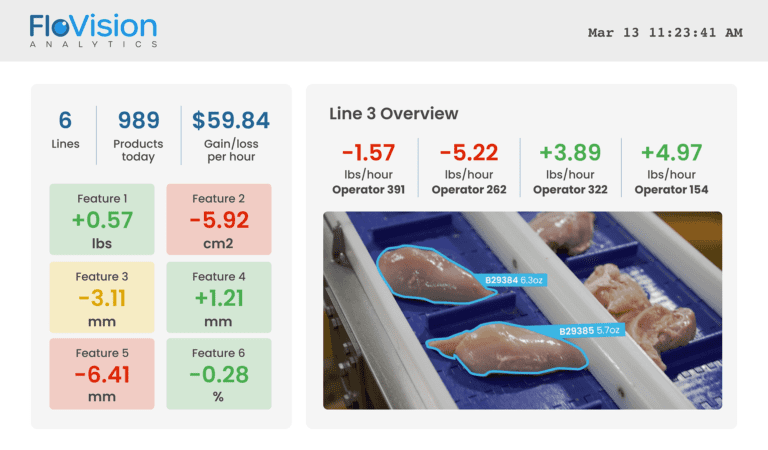
FLOVISION NANO
Compact AI sensor to measure yield and quality at production speed.